

Technology
Sonetics Wireless Team Communication
The Technology In The Apex Headsets
Every headset comes fully loaded with technology that makes your work more enjoyable.

DECT7 Wireless
Talk without removing your hearing protection in full-duplex communication, just like a conference call. DECT7 Wireless technology provides 1,600 ft. line of sight range, which is superior to Bluetooth. It also digitally encrypts all transmissions and is interference-free.

Noise Reduction Rating (NRR)
Sonetics headsets feature an EPA NRR (Noise Reduction Rating) of 24dB in both behind-the-head and hard-hat configurations.

Stereo Listen-Through
Microphones on the forward edge of each ear dome let the user detect outside sound in front versus sound from behind. Listen-through also has a programmable volume and limits all sounds to 85dB to ensure compliance with hearing safety standards.

Auto-Leveling Microphone
Automatically detects the user’s voice against background noise and automatically adjusts when moving from high to low-noise areas.

Noise Suppression
Limits high impulse events (e.g. gunshots) from being transmitted to the user when stereo listen-through is active. This further ensures compliance and situational awareness.
Bluetooth Integration
Connect with other Bluetooth-enabled devices. This allows you to listen to or communicate with cell phones, MP3 players, mobile radios, and computers.

Two-Way Radio Integration
Interface with any two-way portable radio via either wired or wireless connections.
DECT History
DECT (Digital Enhanced Cordless Technology) was created in the early ‘90s in response to the growing need for interference-free wireless communication for household phones. Back then, wireless phones were limited to 49MHz and 900MHz. 49 MHz was quickly abandoned because it lacked the range necessary for basic wireless communication. 900 MHz provided good range, but lacked security, required a lot of power to operate, and was limited to low frequencies.
Later, 2.4GHz became the standard for voice communication. It resolved the previous security and power issues that plagued 900MHz devices, but had less range. However, the biggest issue with 2.4 GHz devices was coexistence. The FCC mandated frequencies and power levels for 2.4GHz devices, but not protocols and requirements for working with similar devices. Some devices worked better than other at this frequency, as wireless devices became more common, so did interference.
WiFi signals use much of the 2.4GHz band and work well despite interference. That’s because it’s tough to detect interruptions in webpages loading, but in communications, interruptions result in drops and pops. When clear communication is critical, this becomes a huge concern. Without coexistence, wireless devices were doomed to intermittent quality. Wireless DECT technology requires coexistence, ensuring secure, interference-free communication with excellent range. DECT is the clear choice for wireless team communication.
DECT Compared To Other Technology
DECT VS. BLUETOOTH
Bluetooth was designed as a short-range wireless standard. While this is great for connecting a cell phone to an earpiece, Bluetooth is not optimal for team communications. Here are just a few reasons why DECT wireless is superior to Bluetooth:
Superior RangeDECT provides 30 times the coverage area of Bluetooth, ensuring interference-free communication – even at large job sites or facilities. Clear CommunicationsBluetooth was designed for data, not voice. When data transfers slowly, it’s not always a big deal, but with voice, slow-downs result in dropped calls and interference – nothing you want taking place while in the midst of crucial communication. No LatencyWith DECT7 your crew can talk and hear each other instantly, just like a face-to-face conversation. Everyone can speak with no detectable lag. The interference-free connection stays clear and steady up to 1,600 feet line-of-sight from the base station or ComHub, without the dropouts and delays you can get on crowded Bluetooth and 900 MHz networks. |
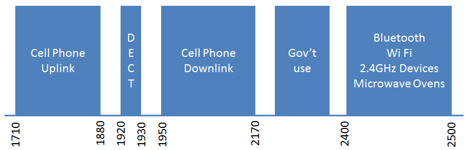
CoexistenceBluetooth is positioned in the ISM band from 2.4Ghz to 2.5Ghz. This is the same spectrum used by all kinds of common devices, including WiFi routers, cell phones, security systems, baby monitors and garage door openers. Do you really want your team’s important communication to risk interference from such a wide-range of competing devices? Rather than using this overcrowded spectrum, DECT operates on frequencies well away from those used by other devices. That’s because these frequencies have been allocated solely for wireless DECT devices, and no other type of device may operate in that spectrum. This means that you don’t have to worry about interference and can be sure that your important communication is heard clearly. |
DECT VS. CELL PHONES
When compared to cell phones, DECT technology is the clear choice for both cost-effective and reliable wireless communication.
CostCell phone usage is expensive. Monthly voice and data plans are required, and in many cases, there are overages with open lines. With DECT, there are no fees outside of your initial equipment investment. |
ReliabilityIn an emergency, your communication system needs to be solid. Cell phone networks typically fail when they are needed most. In times of emergency or disaster, they are easily overloaded. DECT technology operates on a separate frequency spectrum that is separate from cell phone congestion. This means that DECT devices keep working during all conditions – and especially during emergencies. |
DECT VS. TWO-WAY RADIOS
DECT is the proven voice standard in wireless technology. Here are a few reasons why you should choose DECT wireless devices over two-way radios:
Full Duplex CommunicationWith simplex or half-duplex communication, only one person can talk at a time. That’s okay for simple instructions, but what if somebody needs to interrupt radio communication in an emergency? With two-way radios, you can’t. Saving on LicensingTwo-way radio licensing is expensive and time-consuming. So-called “free” channels are unusable for serious applications. DECT frequency licensing fees are prepaid and free to you for the life of any Sonetics product. You can even change locations or job sites without changing radio frequencies or relicensing. Use the savings to outfit more of your team with Sonetics wireless equipment. |
NarrowbandingTo make more radio channels available, the FCC mandated “narrowbanding,” which means less usable frequency to talk and be understood. Certain sounds have become indistinguishable, like “s” and “f.” In the future, even less bandwidth will be allowed, making communication even more difficult. DECT is not affected by narrowbanding. DECT wireless devices operate on a frequency spectrum designated specifically for DECT, so there is no risk of interference from other non-DECT devices. With DECT, you can hear and be heard just like a high-quality phone call. Simple CommunicationWith DECT, you won’t have to learn a new language or specialized techniques to communicate. No more, “Copy that,” or “Over.” |
Secure & Interference-Free Communications
DECT is a wireless protocol that plays well with others. You never have to worry about interference with your other devices.
Listen Before Transmit
Every DECT device listens for other DECT devices before transmitting; if another device is using the same frequency and slot, your device will automatically select another frequency and time slot to avoid interference. This keeps multiple DECT devices from interfering with one another.
Isolated Frequencies
DECT operates on frequencies well away from those used by other devices. In the US, 1920MHz to 1930 MHz are allocated solely for wireless DECT devices; no other device may operate in these frequencies.
Organized Frequencies & Time Map
The DECT standard requires the use of a specific set of frequencies. In the US, there are five frequencies used for DECT. The DECT standard further slices each of these frequencies into 12 uplinks and 12 downlinks, meaning there are 60 time slots of communication available.

Automatic Power Negotiation
DECT devices automatically set power levels to the lowest setting required to maintain a connection. This results in lower power consumption and the ability to have more connections than available slots. While DECT is limited to 60 connections in the U.S., there is no limit to the number of connections with Automatic Power Negotiation in large, distributed facilities. This is because, with distance, the frequencies and slots are reused; the limit of 60 connections still applies in small areas.
Empower Your Team!
Be more productive, more efficient and more connected.
Monday – Friday 6:30 a.m. to 5:00 p.m. PST
sales@sonetics.com
800-833-4558
